

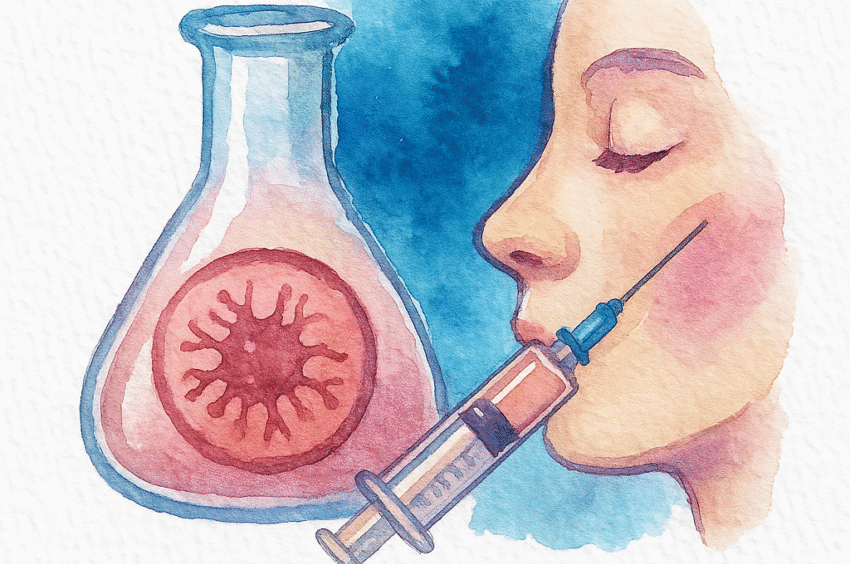
Stem cell therapy have the potential to transform into any cell in the body. The goal is to transform them into fibroblast cells, which renew skin and produce collagen and elastin, and to stimulate the production of these molecules. We use these cells in our treatments.
Although many different branches use it for many different treatment purposes, we in Plastic Surgery frequently use it on the face, neck, décolleté, hands and scalp.
Stem cells vary depending on the cell from which they are derived. It's impossible to grow true, pure stem cells in a clinical setting. However, stem cell-rich cocktails can be obtained through certain purification methods. In our clinic, I prefer adipose tissue-derived stem cells.
First, you'll be examined, then a treatment plan will be developed based on your needs and your doctor's recommendations. Before each treatment, photographs will be taken. A numbing cream will be applied to the treatment area and you'll wait approximately 30 minutes. During this time, local anesthesia is applied to the area where fat will be removed, and the required amount of fat will be extracted through liposuction. Simultaneously, a blood sample will be drawn to obtain PRP. The resulting fat and PRP will undergo a special process to remove excess fat, resulting in a stem cell-rich cocktail. The treatment is then applied to the planned area using fine needles called microfine needles. After the treatment, the damaged cells will begin to heal. You may experience some burning during the procedure, but it will subside within a few seconds.
After the procedure, the treated area should not be washed for 3-4 hours. Avoid using different products that could cause a reaction on the same area.
The patient can return to normal life the next day.
There may be mild swelling, bruising, and a burning sensation in the application area. These usually subside within a few days.
After 1 month of sessions, patients are followed up with additional sessions after 6 months to 1 year.
The treatment is temporary because aging is a continuous and unstoppable process. Therefore, the injected cells will eventually die. The effectiveness can be prolonged by replacing them with new cells, i.e., by additional sessions.